Story
From the drawing board of 1990 to the last car off the line in July 2003. Scroll to move through time; the page changes with the era.
Scroll ↓ to travel
Genèse · 1983 – 1991
Drawing board. The 205 has set the standard; a smaller, cheaper car is needed beneath it.
Design1983
The 205 sets the terms
The Peugeot 205, launched in 1983, defines the modern small Peugeot: light, quick and cleverly packaged. Its sport model is the yardstick the 106 Rallye will later be built to succeed.
Design1990
Rossi and Bracq draw the shape
The exterior is credited to Laurent Rossi under Philippe Couvreur; the interior to Paul Bracq. The platform is a substantial development of the Citroën AX's — the reason for a very short body with a great deal of room.
Launch09/1991
September 1991: the 106
Launched in continental Europe as a three-door hatchback; British cars follow in November. Entry engines are 1.0 and 1.1 litres; the XSi with 1.4 litres leads the performance end.
See the XN · XR · XT →Market08/1992
Five doors, and the first diesel
August 1992 adds a five-door body and the 1.4 TUD3 diesel (50 PS). Fuel injection begins replacing carburettors as emissions rules bite; sources differ on how quickly it spread across the range.
See the XND · XRD · XTD →Motorsport1993
Circuits: Thruxton to the Nürburgring
Daley Thompson wins his class at Thruxton in the National Saloon Car Cup and enters the Willhire 24 Hours at Snetterton. The 106 also begins a Nürburgring 24 Hours run that continues every year until 2003.
Motorsport01/1994
2 January 1994: the Rallye is homologated
The FIA homologates the 1,294 cc Rallye as model 5505 for Groups A and N. A 100 PS, 825 kg, unassisted homologation special becomes the private driver's entry to rallying.
See the Rallye Series 1 →Engine1994
The 1.5 diesel and the 1.6 XSi
The 1.5 TUD5 (58 PS) replaces the 1.4 diesel in late 1994. The XSi grows a 1.6 8v engine with 105 PS.
See the XSi 1.6 →Engine1995
The 106 Électrique
A 20 kW DC motor, 20 × 6 V nickel-cadmium cells and a range of about 80 to 100 km. Around 6,400 are built by 2003.
See the Électrique →Market01/1996
January 1996: the Saxo
Citroën launches the Saxo — almost the same car below the skin, with its own body and nose. From here the two brands sell versions of one platform.
Launch04/1996
April 1996: S16
The sixteen-valve 1.6, 118–120 PS, arrives in Europe as the S16 — a successor to the XSi with disc brakes at all four corners and ABS. Britain sees it a year later as the GTI.
See the S16 · GTI →Design07/1996
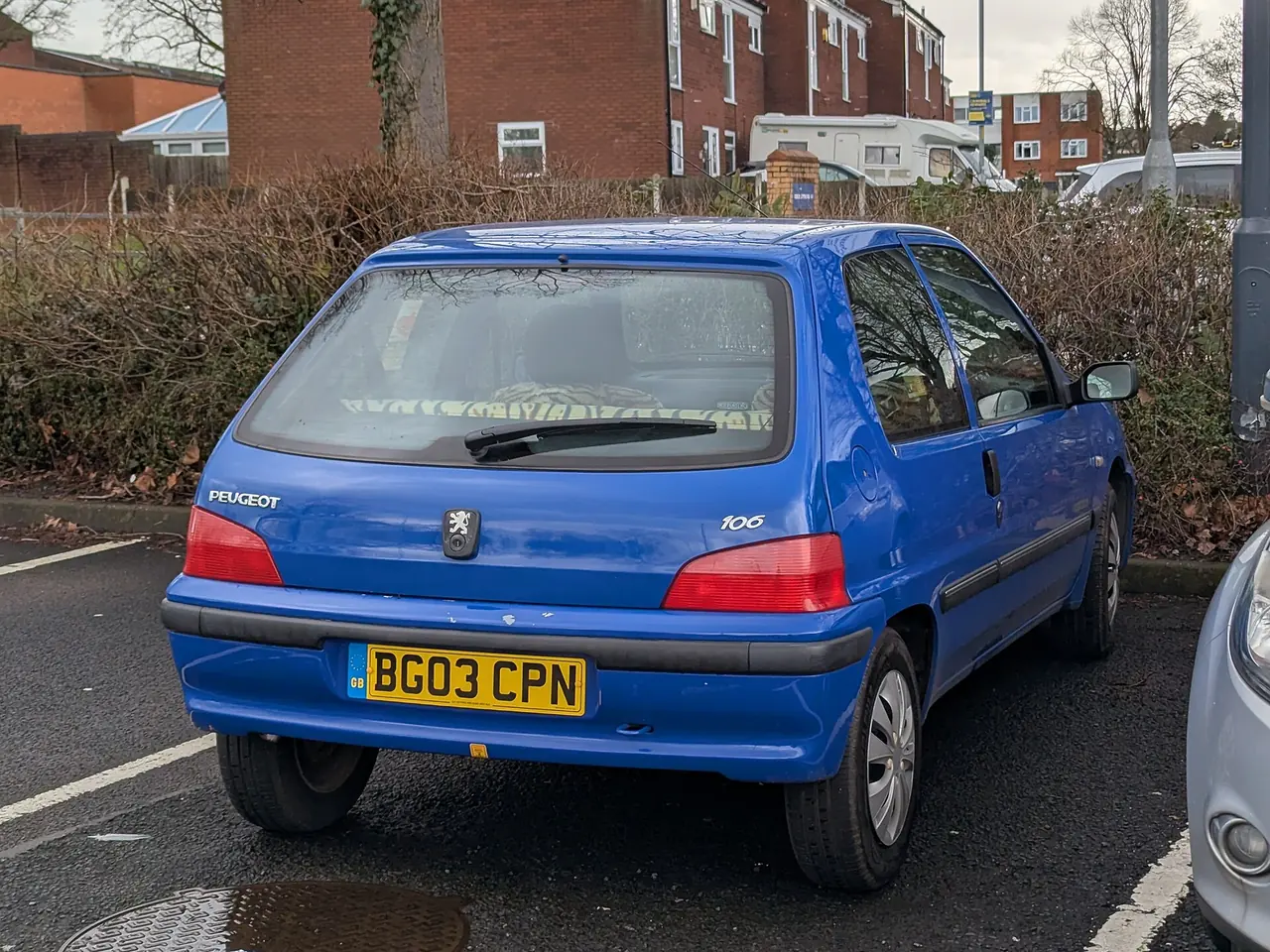
July 1996: Phase II
The facelift adds 114 mm of length, a rounded nose that follows the 406, side-impact bars and — for the first time — driver and passenger airbags. Right-hand-drive cars can finally have power steering.
See the XN · XR · XT →Motorsport1997
The Maxi and Spa
Peugeot Sport builds the 106 Maxi F2 Kit Car; sources disagree on whether it appears in 1996 or 1997. On the circuits, 106s compete in the Spa 24 Hours from 1997 to 1999; the best result is 11th in 1998.
See the 106 Maxi →Market1998
The 206 takes over
At the end of 1998 the 206 arrives. The 106 range is trimmed to Zest models and the GTI, and continues as a cheaper car.
Motorsport2000
Still a national-level rally car
Cédric Robert finishes fifth in the French Rally Championship in a 106 Maxi. The 106 Cup has by now produced Robert, Mark Fisher, Kris Meeke and others.
See the 106 Maxi →End07/2003
July 2003: the last 106
Production ends at Mulhouse, Aulnay-sous-Bois and La Marsa in Tunisia after 2,798,200 cars. The Peugeot 107, a joint venture with Toyota, follows in 2005.
114 millimetres and a new face.
In July 1996 the 106 was rounded off and lengthened. Almost all of the added length went into the front overhang, where a softer nose in the manner of the 406 replaced the straight-cut grille and square lamps. The wheelbase barely moved. The passenger cell is the same shape.
Underneath, the change that mattered was safety: side-impact bars, and driver and passenger airbags for the first time. Right-hand-drive cars, which could not take power steering in Phase I, finally could.
- Length
- 3,564 → 3,678 +114 mm
- Height
- 1,369 → 1,380 +11 mm
- Width
- 1,590 → 1,594 +4 mm
- Wheelbase
- 2,385 → 2,387 +2 mm
2,798,200
106s built · Mulhouse · Aulnay-sous-Bois · La Marsa (Tunisia)
The 106 was assembled in France at Mulhouse and Aulnay-sous-Bois, and in Tunisia at La Marsa. When the 206 arrived at the end of 1998 the range was trimmed to the cheap Zest models and the GTI, and the 106 carried on until July 2003.
Its successor, the 107, was built with Toyota and launched in 2005. Its cousin the Citroën Saxo had already left the stage. The 106 is still raced, still repaired and still a fixture of the used-car small ads.
Meet the variants